Battleship with Hidden Board
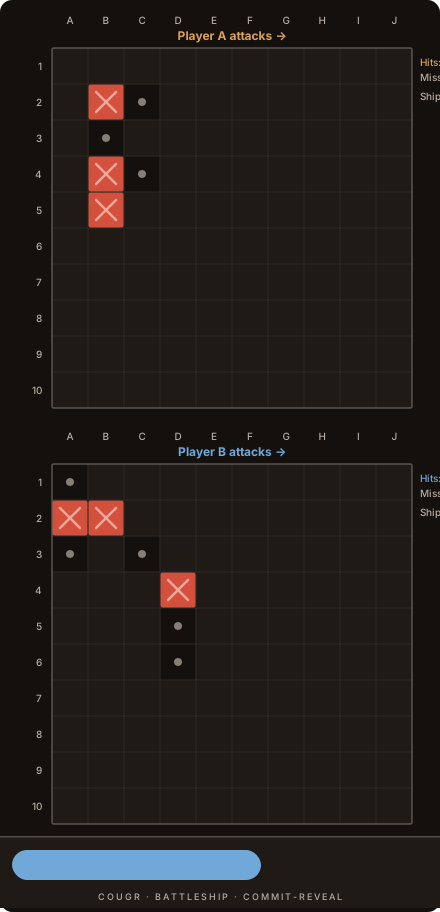
A two-player Battleship game demonstrating hidden information using commit-reveal pattern and Merkle proofs on Stellar Soroban. Players commit their board layouts cryptographically, then prove hit/miss results without revealing unattacked positions.
This example is Cougr's canonical hidden-information reference. It intentionally leans on the stable privacy surface in cougr_core::privacy::stable instead of re-defining Merkle verification inside the example.
Status
Canonical - maintained reference implementation for commit-reveal + selective disclosure on Soroban. Uses cougr-core = "1.1.0", privacy::stable Merkle primitives, and impl_component! macros for standardized serialization.
The Hidden Information Problem
Traditional on-chain games face a challenge: all data is public. In Battleship, if boards are stored directly on-chain, opponents can see ship positions and cheat.
Solution: Commit-Reveal + Merkle Proofs
SETUP PHASE (hide boards)
├─ Player A: commitment = SHA256(board || salt)
├─ Player A: merkle_root = MerkleTree(board).root
├─ Submit (commitment, merkle_root) on-chain
└─ Player B: same process

ATTACK PHASE (selective reveal)
├─ Attacker: attack(x, y)
├─ Defender: reveal_cell(x, y, value, merkle_proof)
├─ Contract: verify proof against merkle_root
└─ Record hit/miss (other cells remain hidden)

END PHASE (anti-cheat)
├─ Winner declared when all ships sunk
└─ Full board can be verified against commitment
Key Properties:
- ✅ Hiding: Unattacked cells remain secret
- ✅ Binding: Can't change board after commitment
- ✅ Selective Reveal: Prove one cell without revealing others
- ✅ Verifiable: Merkle proofs ensure honesty
Game Flow
1. Setup Phase
#![allow(unused)]
fn main() {
new_game(player_a, player_b)
}
Each player computes off-chain:
#![allow(unused)]
fn main() {
// 1. Create 10x10 board (0=water, 1=ship)
let board = [0u32; 100];
board[0] = 1; // Ship at (0,0)

// 2. Compute commitment
let commitment = SHA256(board || salt);

// 3. Build Merkle tree
let merkle_root = MerkleTree::new(board).root();

// 4. Submit on-chain
commit_board(player, commitment, merkle_root)
}
2. Attack Phase
Alternating turns:
Attacker:
#![allow(unused)]
fn main() {
attack(attacker, x, y)
}
Defender:
#![allow(unused)]
fn main() {
// Off-chain: get Merkle proof for cell (x,y)
let proof = merkle_tree.get_proof(x, y);

// On-chain: reveal with proof
reveal_cell(defender, x, y, value, proof)
}
Contract verifies:
- Proof is valid against stored
merkle_root - Records hit (value=1) or miss (value=0)
- Updates ship count
- Switches turn
3. Win Condition
Game ends when one player's ships are all sunk (17 hits total: 5+4+3+3+2).
Contract API
| Function | Parameters | Description |
|---|---|---|
new_game | player_a: Addressplayer_b: Address | Initialize game |
commit_board | player: Addresscommitment: BytesN<32>merkle_root: BytesN<32> | Commit board layout |
attack | attacker: Addressx: u32, y: u32 | Attack coordinates (0-9) |
reveal_cell | defender: Addressx: u32, y: u32value: u32proof: OnChainMerkleProof | Reveal cell with Merkle proof |
get_state | - | Get current game state |
Data Structures
Phase
#![allow(unused)]
fn main() {
enum Phase {
    Setup,    // Waiting for board commitments
    Attack,   // Game in progress
    Finished, // Winner declared
}
}
CellResult
#![allow(unused)]
fn main() {
enum CellResult {
    Unknown, // Not yet attacked
    Miss,    // Attacked, no ship
    Hit,     // Attacked, ship present
}
}
BoardCommitment
#![allow(unused)]
fn main() {
struct BoardCommitment {
    commitment: BytesN<32>,  // SHA256(board || salt)
    merkle_root: BytesN<32>, // Root of Merkle tree
}
}
Stable Merkle Verification
The contract uses Cougr's stable SHA256 Merkle proof contract:
#![allow(unused)]
fn main() {
use cougr_core::privacy::stable::{MerkleProofVerifier, Sha256MerkleProofVerifier};

let verifier = Sha256MerkleProofVerifier;
assert!(verifier.verify(&env, &proof, &merkle_root)?);
}
The leaf payload still binds index || value, but the inclusion proof format and verification rules come from Cougr's stable privacy API.
When to Use Commit-Reveal vs ZK Circuits
| Pattern | Best For | Cost | Complexity |
|---|---|---|---|
| Commit-Reveal + Merkle | Hidden boards, card hands, fog-of-war | O(log n) proof verification | Low - uses standard SHA256 |
| ZK Circuits (Groth16/Poseidon) | Private game logic evaluation, hidden card deals | Single on-chain verification | High - requires circuit compilation |
Use commit-reveal when you need to hide state but reveal it incrementally with verifiable proofs. Use ZK circuits when the game logic itself must remain private (e.g., proving a move is valid without revealing the move).
For a reference ZK implementation, see hidden_hand, which demonstrates circuit-based hidden card dealing with Groth16 proofs.
Storage Model
Committed State
Stored on-chain during setup:
commitment_a/b- SHA256 hash of each player's board with random saltmerkle_root_a/b- root of the Merkle tree built from cell hasheshas_commitment_a/b- flags tracking which players have committed
Both commitments must be submitted before the game transitions to Phase::Attack.
Revealed State
Updated during the attack phase:
attack_grid_a/b- maps cell indices toCellResult(hit/miss)ship_status- tracks remaining ship cells per player (starts at 17)turn_state- tracks current player, phase, and pending reveals
Proven State
The reveal_cell function verifies that disclosed cell values match the original commitment:
- Constructs the expected leaf hash from
(index, value)using the same SHA256 scheme as the commit phase - Validates the
OnChainMerkleProofagainst the storedmerkle_rootusingSha256MerkleProofVerifier - Only if the proof verifies is the hit/miss recorded on-chain
Component Serialization
BoardCommitment uses the impl_component! macro for standardized serialization:
#![allow(unused)]
fn main() {
impl_component!(BoardCommitment, "board", Table, {
    commitment: bytes32,
    merkle_root: bytes32
});
}
This replaces manual byte-level serialization with a type-safe macro that handles big-endian encoding/decoding automatically.
Building & Testing
Prerequisites
- Rust 1.88.0+
- Stellar CLI 25.0.0+ (optional)
Build
cargo build
cargo build --release --target wasm32v1-none
Test
cargo test
Test Coverage (12 tests):
Recommended Testing Approach:
For verification of complex setup commitment sequences and attack/reveal turn-based interactions, utilize GameHarness and Scenario (see sandbox_tests.rs). This ensures cryptographic commitments and Merkle proofs verify correctly across turns.
Test Coverage (10 tests):
- ✅ Game initialization
- ✅ Board commitment
- ✅ Attack and reveal (miss)
- ✅ Attack and reveal (hit)
- ✅ Invalid proof rejection
- ✅ Cannot attack same cell twice
- ✅ Turn enforcement
- ✅ Win condition
- ✅ Component trait serialization (via
impl_component!) - ✅ Turn switching
- ✅ Reveal without pending attack
- ✅ Attack before commit phase
Example Usage
Off-Chain (Player)
#![allow(unused)]
fn main() {
// Build Merkle tree from hashed cell payloads
let mut leaves = Vec::new();
for (idx, &value) in board.iter().enumerate() {
    let leaf = sha256(idx || value);
    leaves.push(leaf);
}
let tree = MerkleTree::from_leaves(&env, &leaves)?;
let root = tree.root();

// Get proof for specific cell
let proof = to_on_chain_proof(&tree.proof(x * 10 + y)?, &env);

// Submit on-chain
client.reveal_cell(&player, &x, &y, &value, &proof);
}
On-Chain (Contract)
#![allow(unused)]
fn main() {
let verifier = Sha256MerkleProofVerifier;
assert!(verifier.verify(&env, &proof, &stored_merkle_root)?);
}
Security Considerations
Secure
- Commitment binding: SHA256 prevents changing board
- Selective reveal: Merkle proofs reveal only attacked cells
- Proof verification: Invalid proofs rejected
- Turn enforcement: Players alternate attacks
️ Important
- Salt randomness: Use 32 cryptographically random bytes
- Merkle tree depth: 7 levels for 100 cells (padded to 128)
- Proof ordering: Siblings must be in correct order
Best Practices
#![allow(unused)]
fn main() {
// ✅ Good: Random salt
let salt = generate_random_bytes(32);

// ❌ Bad: Predictable salt
let salt = BytesN::from_array(&env, &[0u8; 32]);

// ✅ Good: Verify proof before revealing
if !verify_proof(root, index, value, proof) {
    panic!("Invalid proof");
}
}
ECS Architecture
Components
| Component | Fields | Purpose |
|---|---|---|
BoardCommitment | commitment: BytesN<32>merkle_root: BytesN<32> | Cryptographic board commitment |
AttackGrid | cells: Map<u32, CellResult> | Public record of attacks |
ShipStatus | remaining_a: u32remaining_b: u32 | Ship cell counts |
TurnState | current_player: Addressphase: Phasehas_pending: bool | Game state management |
Systems
| System | Responsibility |
|---|---|
| CommitSystem | Validates and stores commitments |
| AttackSystem | Records attack coordinates |
| RevealSystem | Verifies stable OnChainMerkleProof, updates grid |
| WinConditionSystem | Detects when all ships sunk |
Why Merkle Proofs?
Merkle trees enable selective disclosure:
| Approach | Reveal Cost | Privacy |
|---|---|---|
| Full board on-chain | O(1) | ❌ None |
| Reveal entire board per attack | O(n) | ❌ None |
| Merkle proof | O(log n) | ✅ Only attacked cells |
For a 10x10 board:
- Full reveal: 100 cells
- Merkle proof: ~7 hashes (log₂ 128)
Deployment
# Deploy to testnet
stellar keys generate battleship-deployer --network <NETWORK> --fund
stellar contract deploy \
  --wasm target/wasm32v1-none/release/battleship.wasm \
  --source battleship-deployer \
  --network <NETWORK>
Resources
- Cougr Repository
- Merkle Trees
- Commitment Schemes
- hidden_hand - ZK circuit example
- Soroban Documentation
License
MIT OR Apache-2.0