Checkers
Transitional example: This example uses an older Cougr pattern and is preserved for compatibility reference. For the current recommended approach, see
snake.
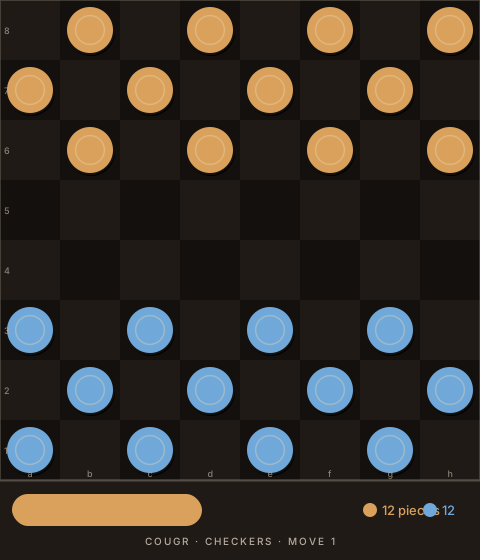
A fully on-chain two-player Checkers game implemented as a Soroban smart contract.
Purpose and pattern
This example demonstrates a turn-based board game with non-trivial rule enforcement - diagonal grid movement, mandatory captures, multi-hop chain captures, king promotion,
and win detection - implemented as plain Rust functions over #[contracttype] structs.
It showcases the simplest possible Cougr-adjacent pattern: component-shaped data types
with hand-written contract storage access, predating the ComponentTrait/GameApp
conventions used by newer examples. It is a useful reference for understanding what a
Soroban board-game contract looks like with no ECS framework involvement at all.
Public contract API
| Function | Parameters | Returns | Description |
|---|---|---|---|
init_game | player_one: Address, player_two: Address | Result<(), CheckersError> | Seeds the standard 8×8 opening position; Player One moves first. Returns AlreadyInitialised if called more than once. |
submit_move | player: Address, from_row: u32, from_col: u32, to_row: u32, to_col: u32 | Result<(), CheckersError> | Validates and applies a step or capture, resolves chain captures, promotes kings, and advances or holds the turn. Returns one of the CheckersError variants on any rule violation. |
get_state | - | Result<GameState, CheckersError> | Full snapshot: board, turn, status, and both player addresses. |
get_board | - | Result<BoardState, CheckersError> | Raw 64-cell board array, row-major order. |
get_current_player | - | Result<Address, CheckersError> | The Address of the player whose turn it currently is. |
Error codes
| Error | Code | Meaning |
|---|---|---|
AlreadyInitialised | 1 | init_game called more than once |
NotInitialised | 2 | Any call before init_game |
NotAPlayer | 3 | Caller is not player_one or player_two |
WrongTurn | 4 | Caller is a registered player but it is not their turn |
NotYourPiece | 5 | Source square is empty or owned by the opponent |
DestinationOccupied | 6 | Target square is already occupied |
IllegalMove | 7 | Move is not a legal diagonal step or jump |
MustCapture | 8 | A capture is available but a non-capture move was attempted |
GameOver | 9 | The game has already ended |
OutOfBounds | 10 | Row or column index ≥ 8 |
ChainCapturePieceMismatch | 11 | During a chain capture the origin square was not the chain square |
NotDarkSquare | 12 | Destination square is a light square (row + col is even) |
Architecture overview
There is no GameApp tick loop. submit_move runs a fixed validation/update pipeline
synchronously on each call:
submit_move
  └─ identify caller, check turn order, bounds, and dark-square rule
  └─ MoveValidationSystem  (systems.rs: legal_steps / legal_captures)
       → confirms the requested move is a legal step or capture for this piece
  └─ forced-capture check   (systems.rs: any_capture_available)
       → rejects a non-capture move if any capture exists for the player
  └─ apply move + remove captured piece
  └─ PromotionSystem        (systems.rs: maybe_promote)
       → crowns a man reaching the opponent's back rank
  └─ chain-capture detection (systems.rs: legal_captures on the landing square)
       → holds the turn and records the active square if another capture is available
  └─ EndConditionSystem     (systems.rs: check_winner)
       → declares a winner on piece-count exhaustion or no legal moves
  └─ TurnSystem
       → advances current_player, or holds it during a chain capture
components.rs holds the data shapes (BoardComponent, TurnComponent,
GameStatusComponent, GameStatus, the public GameState/BoardState view types, the
internal ChainCapture tracker, and the small SmallVec4 fixed-capacity collection).
systems.rs holds the pure, storage-free game-logic functions (move/capture legality,
promotion, win detection, board initialisation). lib.rs is the only module that touches
env.storage(); it loads components, calls into systems.rs, and writes the results
back.
Storage model
All state lives in persistent storage, under five top-level Symbol keys:
| Key | Contents |
|---|---|
BOARD | BoardComponent - 64-cell flat grid |
TURN | TurnComponent - current player and move number |
STATUS | GameStatusComponent - active/finished and winner |
P1 | Address of Player One |
P2 | Address of Player Two |
CHAIN | ChainCapture - present only while a multi-hop capture sequence is in progress |
Persistent storage (rather than instance storage) is used because each key is read and
rewritten independently inside submit_move - the board, turn, and status are not bundled
into one aggregate struct in this example, so per-key persistent entries map directly onto
that access pattern. The CHAIN key is removed as soon as a turn fully ends; its absence
is what tells submit_move that no multi-hop sequence is active, so it doubles as both
data and a lightweight state flag.
Main gameplay flow
- Deployer calls
init_game(player_one, player_two). The board is seeded with the standard 12-piece-per-side opening position; Player One moves first. - Player One calls
submit_movewith a(from_row, from_col)→(to_row, to_col)pair. The contract checks turn order, bounds, the dark-square rule, piece ownership, and move geometry (diagonal step or jump). - If any capture is available for the mover anywhere on the board, a non-capture move is
rejected with
MustCapture- captures are mandatory, not optional. - On a legal capture, the jumped piece is removed. If the landing square has a further
capture available, the turn is held: the same player must continue jumping with the
same piece (tracked via the
CHAINkey) until no further capture exists. - A man reaching the opponent's back rank is promoted to a king immediately after the move that lands it there, before chain-capture continuation is checked.
- After each move,
EndConditionSystemchecks whether either side has no pieces left or no legal move available; if so,STATUSflips toFinishedwith a recorded winner. - Players alternate
submit_movecalls until a winner is recorded;get_state,get_board, andget_current_playerprovide read-only views at any point.
Cougr APIs used
cougr_core::component::ComponentTrait- gives each component (BoardComponent,TurnComponent,GameStatusComponent) acomponent_type()symbol and byte-levelserialize/deserialize, chosen here because the game has a single fixed set of components per instance rather than a dynamic entity population that would benefit fromSimpleWorld/SimpleQueryBuilderscanning.
Per the API usage guidance in EXAMPLE_STANDARD.md §8, GameApp/ScheduleStage,
SimpleWorld, auth, and privacy APIs do not apply here: there is exactly one
fixed-shape game state per contract instance, one synchronous validation pipeline per
call, no session-key or multi-device flow, and no hidden information or proof submission.
This example is kept as a transitional reference precisely because it predates Cougr's
GameApp tick conventions - see snake for the current recommended approach.
Build and test commands
cargo test
stellar contract build
Known limitations
- Does not use
GameApp,ScheduleStage, orSimpleWorld- game logic is invoked directly from contract entrypoints rather than through a tick-based scheduler, since a two-player, one-decision-per-call board game does not require staged scheduling or entity queries. - No timeout/forfeit mechanism for an unresponsive player.
- No draw detection (e.g., repetition or no-progress rules); a game can only end by piece exhaustion or a player having no legal move.
- No spectator or replay API beyond the three read-only getters.