Staked Tournament
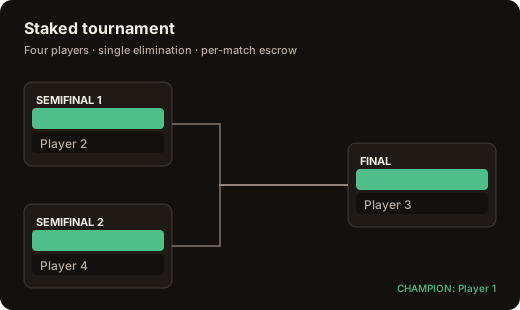
Purpose and pattern
staked_tournament demonstrates per-match token escrow for a four- or
eight-player, single-elimination bracket. Each match stores its own stake
flags and settlement state, and a settled winner is assigned to the next
round automatically. This is a pattern for multi-match staked play, not a
production tournament product.
Public contract API
| Function | Parameters | Returns | Description |
|---|---|---|---|
initialize | creator: Address, entrants: Vec<Address>, token_address: Address, stake: i128, timeout_seconds: u64 | () | Creator-authorized setup for four or eight unique entrants. |
stake_match | player: Address, match_id: u32 | () | Transfers the player's stake into the contract before the match deadline. |
resolve_match | winner: Address, match_id: u32 | () | Winner-authorized settlement after both players stake; pays the pot and advances the winner. |
forfeit_no_show | match_id: u32 | () | After the deadline, refunds and advances the sole player who staked. |
get_match | match_id: u32 | MatchRecord | Reads the players, stake flags, deadline, and settlement result for one match. |
champion | - | Option<Address> | Reads the final winner once the bracket is complete. |
Architecture overview
The contract stores the bracket as a flat list of match records. Every match has its own two stake flags, deadline, winner, and precomputed next-round destination. Normal settlement pays that match's two-stake pot; no-show settlement returns the present player's own stake. Both paths use the same winner-advancement function, which fills the appropriate parent match slot and starts its deadline once both players are assigned.
There is no GameApp tick or ECS integration. resolve_match trusts an
authenticated winner to report the result, so a real game should call an
escrow settlement path only after verifying its own match outcome.
Storage model
Tournament configuration, the fixed bracket slots, and champion are stored together in instance storage. The example keeps all bracket data in one instance value for clarity; a longer-running tournament would need an explicit storage and TTL strategy.
Main gameplay flow
- The creator initializes the contract with four or eight unique players, a Soroban token address, a positive stake, and a timeout.
- Each first-round player calls
stake_match; their stake moves to the contract and is tracked only in that match's record. - After both stakes arrive, the authenticated winner calls
resolve_match. The winner receives both stakes and advances automatically. - If exactly one player stakes before the deadline, anyone can call
forfeit_no_showafter it expires. The present player's stake is returned and they advance, so the next round can proceed. - The two advancing players stake in their new match. The final settlement records the champion.
Cougr APIs used
None. This example isolates the Soroban token interface and bracket escrow pattern; it does not use Cougr ECS, scheduler, auth, or standards APIs.
Build and test commands
cd examples/staked_tournament
cargo test
stellar contract build
Known limitations
- Only four- and eight-player single-elimination brackets are supported.
- No seeding, ranking, matchmaking, house fee, or dispute resolution is included.
- The winner self-reports normal match results; the contract does not verify gameplay outcomes.
- A no-show refund requires exactly one player to have staked. A match where neither player stakes, or where both stake and then disappear, needs an external decision process and cannot advance automatically.
- This example is not a production tournament product and makes no claim about live assets or mainnet deployment.